In addition, recognizing that the corruption problem is as much a moral as a governance issue, Indians have tapped the country's spiritual traditions to beat corruption. For example, business leaders ranging from Fortune 500 company managers to business students have studied an ancient system of mind purification called Vipassana; research suggests that Vipassana is effective in helping to understand the self-destructive nature of corruption.
A senior Indian government official, D R Parihar, in his research study "The Impact of Vipassana on Government", concluded that Vipassana has a direct role to play in improving public administration. Leading Indian corporates such as ONGC, Indian Railways, auto maker Mahindra & Mahindra, and nuclear facilities such as the Bhabha Atomic Research Center regularly send employees to attend Vipassana courses.
Read more: http://www.atimes.com/atimes/South_Asia/HF29Df03.html
Thursday, June 29, 2006
Monday, June 26, 2006
GOD'S DOMINION (excerpt)
Since the retreats offer almost no opportunity to break the vows, keeping them is seldom a problem. But, once outside again, the world presents more than enough opportunities; it presents encouragement and even pressure to break them. When I spoke to Goenka about how difficult it was to stop drinking altogether for personal and social reasons, he advised me not to force it, since force would only increase the craving which was at the core of drinking. Be aware, be moderate, keep meditating — he said — and when that particular habit was ready to surface, as a sensation, it would be erased naturally. And, despite my scepticism, that is what happened. I came out of a twenty-day retreat in 1982 and found, in the weeks and months and years that followed, I had not the least desire for a glass of beer or a sip of champagne.
"I’m worried I’m being brainwashed," I said to Goenka in a state of panic midway through my second retreat.
"You are being brainwashed," he answered. "Your brain is being washed!"
It was a matter of faith again, I suppose, but faith tested rigorously, suspiciously, against what it promised and what it delivers. "Do not simply believe whatever you are told, or whatever had been handed down from past generations, or what is common opinion, or whatever the scriptures say," Buddha — is reputed to have — said. "Do not accept something as true merely by deduction or inference, or by considering outward appearances, or by partiality for a certain view, or because of its plausibility, or because your teacher tells you it is so. But when you yourselves directly know that these principles are unwholesome, blameworthy, condemned by the wise — when adopted and carried out they lead to harm and suffering — then you should abandon them. And when you yourselves know that these principles are wholesome, blameless, praised by the wise — when adopted and carried out they lead to welfare and happiness — then you should accept and practise them."
Read more: http://web.archive.org/web/20061015235040/http://rongrahamcanada.com/books/gods.html
"I’m worried I’m being brainwashed," I said to Goenka in a state of panic midway through my second retreat.
"You are being brainwashed," he answered. "Your brain is being washed!"
It was a matter of faith again, I suppose, but faith tested rigorously, suspiciously, against what it promised and what it delivers. "Do not simply believe whatever you are told, or whatever had been handed down from past generations, or what is common opinion, or whatever the scriptures say," Buddha — is reputed to have — said. "Do not accept something as true merely by deduction or inference, or by considering outward appearances, or by partiality for a certain view, or because of its plausibility, or because your teacher tells you it is so. But when you yourselves directly know that these principles are unwholesome, blameworthy, condemned by the wise — when adopted and carried out they lead to harm and suffering — then you should abandon them. And when you yourselves know that these principles are wholesome, blameless, praised by the wise — when adopted and carried out they lead to welfare and happiness — then you should accept and practise them."
Read more: http://web.archive.org/web/20061015235040/http://rongrahamcanada.com/books/gods.html


Wednesday, June 14, 2006
Vipassana: Notes from Spiritual Boot Camp
I recently returned from a ten day meditation "retreat" at one of S.N. Goenka's Vipassana Centres. This was no relaxing vacation. At Vipassana, I delved into the dark depths of my psyche and came out with a profound attitude adjustment that helped me to find the root cause of a mysterious illness and improved my ability to stay calm. Making the choice to attend Vipassana was one of the most important things I have ever done. This essay is my attempt to encourage readers to consider giving it a try. Courses are offered all over the world for free on a donation-only basis (including room and board!)
Read more: http://liveweb.archive.org/http://www.margonaut.com/vipassana.htm
Read more: http://liveweb.archive.org/http://www.margonaut.com/vipassana.htm
Monday, June 12, 2006
Where management meets Vipassana : SCMHRD Director’s interview
According to Director Prof KS Subramanian, SCMHRD differs from other b-schools of its league in that it looks upon students as individuals who are giving a last shot at professional education in their life.
“It is not going to happen that these students will go back to organized learning on a two year basis again in their lives. Having said that, we want to build as many competencies as possible in them and contribute talented individuals to the society and industry,” says Prof Subramanian.
Perhaps the most talked about dimension of SCMHRD is its stress on spiritual learning and yoga, Vipassana sessions and a strict code of conduct on campus. Mobile phones are banned on campus and there are strict restrictions on public display of affection. Prof Subramanian strongly advocates these rules.
“You have come here to learn in a personal teaching environment. Why carry a mobile phone and let yourself and others be disturbed? It frustrates the teachers also disturbs others.”
Read more: http://www.pagalguy.com/?p=396
“It is not going to happen that these students will go back to organized learning on a two year basis again in their lives. Having said that, we want to build as many competencies as possible in them and contribute talented individuals to the society and industry,” says Prof Subramanian.
Perhaps the most talked about dimension of SCMHRD is its stress on spiritual learning and yoga, Vipassana sessions and a strict code of conduct on campus. Mobile phones are banned on campus and there are strict restrictions on public display of affection. Prof Subramanian strongly advocates these rules.
“You have come here to learn in a personal teaching environment. Why carry a mobile phone and let yourself and others be disturbed? It frustrates the teachers also disturbs others.”
Read more: http://www.pagalguy.com/?p=396
Tuesday, June 6, 2006
Alt Rocker Finds Inner Peace

Take Weezer's frontman, send him to Harvard, and have him meditate for two hours a day. What do you get? One calm Rivers.
Meet Rivers Cuomo, the famously self-tortured lead singer, guitarist, and songwriter of the Grammy-nominated band Weezer. They're the alternative-rock band who sing "Beverly Hills" and who made that great Spike Jonze-directed video "Buddy Holly." In the last few years Cuomo has been practicing Vipassana meditation , whose goal is, according to the Vipassana Mediation website, "the total eradication of mental impurities and the resultant highest happiness of full liberation.
Read More: http://www.beliefnet.com/Entertainment/Music/2006/06/Alt-Rocker-Finds-Inner-Peace.aspx
Sunday, May 28, 2006
On a mind trip
To be still. That is in your mind. Is it possible? In the rapids of life, who has the time for it? A relative went in for Vipassana meditation and dropped subtle to obvious hints about its effectiveness.
Bah, I said using the same route. First subtle and then obvious. A crisis in life pushed me in various directions. I did everything I could grasp — reiki, past life regression, nadi astrology, tarot, and even books by authors who are experts on ‘how to get rid of’ anything from migraine to bad habits.
None helped. And I surprised myself by wanting to enrol for a Vipassana meditation course. On seeing my relative’s jaw drop, I said, ‘Please do it before I change my mind’.
Read more: http://www.financialexpress.com/news/on-a-mind-trip/94210/0
Bah, I said using the same route. First subtle and then obvious. A crisis in life pushed me in various directions. I did everything I could grasp — reiki, past life regression, nadi astrology, tarot, and even books by authors who are experts on ‘how to get rid of’ anything from migraine to bad habits.
None helped. And I surprised myself by wanting to enrol for a Vipassana meditation course. On seeing my relative’s jaw drop, I said, ‘Please do it before I change my mind’.
Read more: http://www.financialexpress.com/news/on-a-mind-trip/94210/0
Tuesday, January 10, 2006
How to Get Smarter, One Breath at a Time
At 4:30, when most of Wall Street is winding down, Walter Zimmermann begins a high-stakes, high-wire act conducted live before a paying audience. About 200 institutional investors—including airlines and oil companies—shell out up to $3,000 a month to catch his daily webcast on the volatile energy markets, a performance that can move hundreds of millions of dollars. "I'm not paid to be wrong—I can tell you that," Zimmermann says. But as he clicks through dozens of screens and graphics on three computers, he's the picture of focused calm. Zimmermann, 54, watched most of his peers in energy futures burn out long ago. He attributes his brain's enduring sharpness not to an intravenous espresso drip but to 40 minutes of meditation each morning and evening. The practice, he says, helps him maintain the clarity he needs for quick, insightful analysis—even approaching happy hour. "Meditation," he says, "is my secret weapon."
Read more: http://www.time.com/time/magazine/printout/0,8816,1147167,00.html
Read more: http://www.time.com/time/magazine/printout/0,8816,1147167,00.html
Monday, September 19, 2005
Weezer: Distraction Subtraction

"It's funny, I was just talking to the president of our record company, and he was concerned that our younger fans were going to be freaked out because I was meditating or whatever," he laughs. "Like, they might think I'm some kind of hippie or something. But honestly, it's all perfectly normal. People think I'm a freak or something, but I'm actually a really normal guy."
Read more: http://www.mtv.com/bands/w/weezer/news_feature_091905/
Wednesday, August 17, 2005
Just Say "Ommmmm . . . "

A local experiment suggests teaching prison inmates meditation could be an effective form of rehab, among other benefits.
It was called the North Rehabilitation Facility, a nice name for jail. The 300-bed unit of King County's correctional system in Shoreline was rated minimum security, but there was nothing minimal about the problems that brought its inmates there. Most were serious substance abusers as well as convicted criminals, with discouraging rates of recidivism.
Read more : http://www.seattleweekly.com/2005-08-17/news/just-say-ommmmm-nbsp-nbsp-nbsp-nbsp-nbsp/
Wednesday, July 6, 2005
Spotlight: A Life Sentence

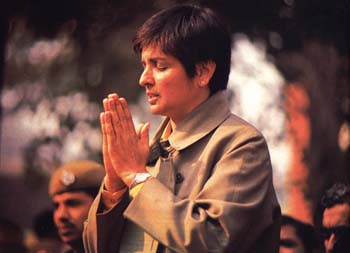
The film tells the story of Kiran Bedi, the woman who took over as inspector general of India’s prisons in 1993, determined to change how things were done.
The previous jailers saw administering punishment as their job: the worse the punishment, the less likely inmates would return. Bedi saw this as the problem: giving inmates a steady diet of punishment without rehabilitation did not prepare them to live in society. She was right; most inmates ended up returning again and again.
Read more : http://english.epochtimes.com/news/5-7-6/30016.html
Sunday, June 19, 2005
Confessions of a tourist: I bent over backwards for her
There are lots of good reasons to go on a meditation retreat in India, but stalking your ex, I discover, isn’t one of them.
Read more : http://www.timesonline.co.uk/tol/travel/article534744.ece
Read more : http://www.timesonline.co.uk/tol/travel/article534744.ece
Wednesday, May 25, 2005
'Vipassana' doc showcases the power of meditative insight
What could possibly make hardened criminals locked up in one of the worst prisons on earth say that they are actually glad to be there? What powerful force could drive violent offenders to weep joyfully and unabashedly?
Read more: http://www.metroactive.com/papers/sonoma/05.25.05/vipassana-0521.html
Tuesday, April 26, 2005
Connections on and off the course

Read more: http://www.smh.com.au/news/Business/Connections-on-and-off-the-course/2005/04/25/1114281505152.html?oneclick=true
Monday, May 26, 2003
Pure Attention
You refer to vipassana as a pure science. Why so?
For me, Buddha was a great scientist. He discovered something which was lost, which people had forgotten. In science, there is no blind faith, no blind belief. You experiment with things. If many people experiment and get the same result, they accept it. Moreover, Buddha kept on saying, "Buddha or no Buddha, the law of nature, dhamma, prevails always." The law remains the same. If you generate anger, you are bound to become miserable. If you generate peace, love and compassion, you are bound to have peace and harmony. This law was always there, before Buddha and after Buddha.
Could you explain the vipassana technique that you teach, because it seems that it's taught differently in various cultures and traditions?
Before I give an explanation of what I am teaching, one point should be clear: I am not here to condemn any technique or to compare or contrast whatever technique people teach in the name of vipassana. I teach only what I got from the tradition.
The whole technique is investigating reality at the experiential level, within oneself. In this technique, it is very important that people stay at a congenial place where they can meditate with the least amount of disturbance. If one is connected with outside objects, one cannot go to the depth of the mind.
...............................
Read more: http://archive.thebuddhadharma.com/issues/2003/spring/goenka_pure_attention.html
For me, Buddha was a great scientist. He discovered something which was lost, which people had forgotten. In science, there is no blind faith, no blind belief. You experiment with things. If many people experiment and get the same result, they accept it. Moreover, Buddha kept on saying, "Buddha or no Buddha, the law of nature, dhamma, prevails always." The law remains the same. If you generate anger, you are bound to become miserable. If you generate peace, love and compassion, you are bound to have peace and harmony. This law was always there, before Buddha and after Buddha.
Could you explain the vipassana technique that you teach, because it seems that it's taught differently in various cultures and traditions?
Before I give an explanation of what I am teaching, one point should be clear: I am not here to condemn any technique or to compare or contrast whatever technique people teach in the name of vipassana. I teach only what I got from the tradition.
The whole technique is investigating reality at the experiential level, within oneself. In this technique, it is very important that people stay at a congenial place where they can meditate with the least amount of disturbance. If one is connected with outside objects, one cannot go to the depth of the mind.
...............................
Read more: http://archive.thebuddhadharma.com/issues/2003/spring/goenka_pure_attention.html
Saturday, July 20, 2002
WHY I’M NOT A CATHOLIC — Globe and Mail — July 20, 2002
Wandering around India in the early 1970s, I was amused rather than swayed by the gurus who were attracting hordes of Western seekers by means of abstract philosophies, physical distortions, magic tricks, sexual licence, or ganja. But then I happened upon S. N. Goenka. Clean-cut, clean-shaven, clean-living, he certainly didn’t look or act like any other baba. In fact, he had been a prominent businessman and a leader of the traditional Hindu community in Rangoon before he discovered the ancient technique he now taught. It cured him of severe migraines — something none of the medical specialists he had consulted in Switzerland or the United States were able to do — and in 1969 he decided to dedicate the rest of his life to teaching it beyond the borders of Burma, where it had been passed down like a closely guarded secret for more than 2,500 years.
Step by step, for ten days, he taught me how to meditate, and
every evening he gave a lecture on why it worked. There was nothing complicated or occult about it: no doctrinal texts to study or esoteric languages to learn, no mantras or visualizations, no prayers or prostrations, no icons or joss sticks. God and the afterlife weren’t denied so much as set aside, as were reincarnation and nirvana too, and nothing was to be accepted until it had been experienced. Ethical behaviour wasn’t a matter of Mr. Goenka’s laying down the law with promises of heaven or threats of hell; it was reduced to the fact that hurting others by word, thought, or action inevitably boomerangs back upon oneself as some form of misery. Most of all, I responded to the logic that no god, priest, swami, or saint — least of all, Mr. Goenka himself — could redeem me from the consequences of my own deeds.
Read more: http://web.archive.org/web/20061015235142/http://rongrahamcanada.com/article/catholic.html
Step by step, for ten days, he taught me how to meditate, and
every evening he gave a lecture on why it worked. There was nothing complicated or occult about it: no doctrinal texts to study or esoteric languages to learn, no mantras or visualizations, no prayers or prostrations, no icons or joss sticks. God and the afterlife weren’t denied so much as set aside, as were reincarnation and nirvana too, and nothing was to be accepted until it had been experienced. Ethical behaviour wasn’t a matter of Mr. Goenka’s laying down the law with promises of heaven or threats of hell; it was reduced to the fact that hurting others by word, thought, or action inevitably boomerangs back upon oneself as some form of misery. Most of all, I responded to the logic that no god, priest, swami, or saint — least of all, Mr. Goenka himself — could redeem me from the consequences of my own deeds.
Read more: http://web.archive.org/web/20061015235142/http://rongrahamcanada.com/article/catholic.html
Friday, August 10, 2001
Meditation holds silent promise for prisoners

Several men in bright-orange outfits sink into fluffy cushions for daily meditation. They remove their shoes, close their eyes, slow their breathing to a languorous pace.
The room is still and serene on this recent afternoon as they head down Buddha's Eight-Fold Path toward the Four Noble Truths -- until the material world crashes in.
"Attention all residents!" crackles a loudspeaker. "Report back to your dorms! In-room head count!"
Inhale, exhale. Such is enlightenment, jailhouse-style.
Here, at the Northern Rehabilitation Facility, a minimum-security jail in Shoreline, Buddhist meditation -- and its quest for freedom from suffering -- is seemingly at odds with incarceration.
Read more: http://www.seattlepi.com/local/article/Meditation-holds-silent-promise-for-prisoners-1062411.php
Tuesday, July 10, 2001
Prisoners benefit from meditation

Vipassana has been tried on an experimental basis in Lancaster prison in the UK. The research was presented at the Royal College of Psychiatrists annual conference in London.
Read more: http://news.bbc.co.uk/2/hi/health/1430311.stm
Monday, January 1, 2001
Ten Days of Silence: Inside a Vipassana Retreat
Nandini Naik, 21, is a religious studies major at Colby College, Maine. Her spiritual quest has led her to Zen meditation, Reiki, and most recently, a 10-day Vipassana retreat in her native India. In a recent interview, she described what it was like to spend over a week in silent meditation and self-observation.
Read more : http://www.beliefnet.com/Faiths/Hinduism/2001/01/Ten-Days-Of-Silence-Inside-A-Vipassana-Retreat.aspx
Read more : http://www.beliefnet.com/Faiths/Hinduism/2001/01/Ten-Days-Of-Silence-Inside-A-Vipassana-Retreat.aspx
Sunday, November 12, 2000
Superscience : An interview with S. N. Goenka
S. N. Goenka came to New York this fall for the Millennium World Peace Summit at the United Nations. He was interviewed there by Helen Tworkov.
What happens during a ten-day Vipassana course?
The whole process is one of total realization, the process of self-realization, truth pertaining to oneself, by oneself, within oneself. It is not an intellectual game. It is not an emotional or devotional game: “Oh, Buddha said such and such . . . so wonderful . . . I must accept.” It is pure science. I must understand what’s happening within me, what’s the truth within me. We start with breath. It looks like a physical concept, the breath moving in and moving out. It is true. But on the deeper level the breath is strongly connected to mind, to mental impurities. While we’re meditating, and we’re observing the breath, the mind starts wandering—some memory of the past, some thoughts of the future—immediately what we notice is that the breath has lost its normality: it might be slightly hard, slightly fast. And as soon as that impurity is gone away it is normal again. That means the breath is strongly connected to the mind, and not only mind but mental impurities. So we are here to experiment, to explore what is happening within us. At a deeper level, one finds that mind is affecting the body at the sensation level.
This causes another big discovery—that you are not reacting to an outside object. Say I hear a sound and I find that it is some kind of praise for me; or I find someone abusing me, I get angry. You are reacting to the words at the apparent level, yes, true. You are reacting. But Buddha says you are actually reacting to the sensations, body sensations. That when you feel body sensation and you are ignorant, then you keep on defiling your mind by craving or by aversion, by greed or by hatred or anger. Because you don’t know what’s happening.
Read more : http://www.tricycle.com/interview/superscience
Subscribe to:
Posts (Atom)