www.dhamma.org

For more information about Vipassana, please visit www.dhamma.org

Tuesday, October 1, 2013

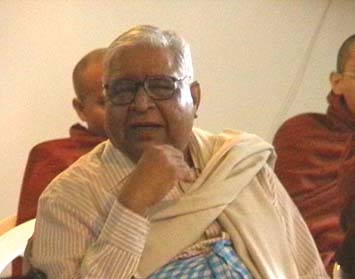
Vipassana guru S N Goenka dies


Renowned spiritual leader and Vipassana guru Satya Narayan Goenka died due to old age on Sunday night. He was 89. The funeral is scheduled for Tuesday.

Goenka, who was conferred the Padma Bhushan for social work last year, started teaching meditation to the public in India in 1969. In 1976, he set up the Vipassana International Academy — also known as Dhamma Giri — in Igatpuri, about 200 km from here in Nashik district.

Besides India, Vipassana centres have come up in countries like the US, Canada, Australia, New Zealand, France, the United Kingdom, Japan, Sri Lanka, Nepal, Myanmar and Thailand under his guidance.


More info: http://www.dhamma.org/

S. N. Goenka, Pioneer of Secular Meditation Movement, Dies at 90

S. N. Goenka, leader of an enormously popular worldwide insight meditation (Vipassana) movement, died on September 29 of natural causes in Mumbai, India. He was 90 years old.


Goenka’s transformation of vipassana into a standalone movement has had a profound effect on general conceptions of Buddhist practice in the modern world. By presenting meditation as a universal art of living, Goenka enabled practice to further permeate societies as a secular technique, especially in Europe and North America. His later efforts, such as founding a research institute to study vipassana’s social effects and, in 2002, touring 35 North American cities to spread the word about meditation, further reinforced the popular message that meditation is nonreligious. His practical presentation has influenced many, particularly in the West, to see vipassana as essentially about one’s current life and how it is lived.

Goenka’s view of vipassana as an art of living extends to the very end of life, for to learn how to live is to learn how to die: “Vipassana teaches the art of dying: how to die peacefully, harmoniously. And one learns the art of dying by learning the art of living: how to become master of the present moment.”

Goenka is reported to have passed away peacefully in his home. That his life ended in such an everyday setting fits with his vision of meditation. “When your own death comes, observe it, at the level of sensations,” writes Goenka. “Everyone has to observe one’s death: coming, coming, coming, going, going, going, gone! Be happy!”

Full article: https://tricycle.org/trikedaily/s-n-goenka-pioneer-secular-meditation-movement-dies-90/

More info: http://www.dhamma.org/

Monday, September 30, 2013

Remembering S.N. Goenka

S.N. Goenka (right) with Munindra (center) and author/teacher Christopher Titmuss (left)

Today we say goodbye to a teacher who had an immense impact on the world. S.N. Goenka was a pioneer in making Vipassana meditation widely available to a secular audience. Over 170 meditation centers have been established around the globe under his auspices. His legacy will resound indefinitely.

By learning to remain balanced in the face of everything experienced inside, one develops detachment towards all that one encounters in external situations as well. However, this detachment is not escapism or indifference to the problems of the world. Those who regularly practice Vipassana become more sensitive to the sufferings of others and do their utmost to relieve suffering in whatever way they can—not with any agitation, but with a mind full of love, compassion, and equanimity. They learn holy indifference—how to be fully committed, fully involved in helping others, while at the same time maintaining balance of mind. In this way they remain peaceful and happy while working for the peace and happiness of others.

This is what the Buddha taught: an art of living. He never established or taught any religion, any “ism.” He never instructed those who came to him to practice any rites or rituals, any empty formalities. Instead, he taught them just to observe nature as it is by observing the reality inside. Out of ignorance, we keep reacting in ways which harm ourselves and others. But when wisdom arises—the wisdom of observing reality as it is—this habit of reacting falls away. When we cease to react blindly, then we are capable of real action—action proceeding from a balanced mind, a mind which sees and understands the truth. Such action can only be positive, creative, helpful to ourselves and to others.

Full article: https://web.archive.org/web/20131006152605/http://blog.shambhala.com/2013/09/30/remembering-s-n-goenka/

More info: http://www.dhamma.org/

Tuesday, July 2, 2013

Mind Surgery: Changing the Habit of a Lifetime

...........
Sitting for eleven hours a day practicing Vipassana was painful. My back hurt. My legs were in agony. My buttocks went numb. My mind was filled with aversion, distraction and frustration. I willed for the sessions to be over. I underestimated the time remaining. I couldn't imagine how I'd get through the hour, let alone the next five days. But slowly, slowly, I persisted and my attention increased and sharpened so that eventually I became totally subsumed in the present moment and I surrendered to "reality as it was, not as I wanted it to be". And the pain... It evaporated. Having taken baby steps to train my mind, I found that my senses became elevated and my environment radiated with beauty. I found myself in a state of peace and I felt compassion towards the people around me and a gentleness towards myself I've always lacked.


I believe I learned more about the nature of the mind and the art of living in these ten days than three years studying psychology and philosophy at one of the most prestigious universities in the world. How funny, I thought, that the most renowned Western philosophers contemplate consciousness by dreaming up alternate possible worlds sitting in their armchairs while their counterparts in India experience the actual world sitting cross legged on the ground.


More Information: http://www.huffingtonpost.co.uk/claudia-bicen/mind-surgery-changing-the_b_2639560.html

Dhamm Dipa: https://www.dipa.dhamma.org

Friday, May 17, 2013

Vipassana meditation retreat in Maryland


A few years ago, Yetka Zarrinkafsh was at a crossroads. She says her life was extremely busy and she needed somewhere to be quiet. That somewhere was a special meditation retreat where they practice the ancient Buddhist technique of Vipassana, meditation in complete silence.

The retreat lasts all day long, every day and with a silent break for meals and sleep. No phones. No TVs. No reading. No writing.

ABC7 was allowed unprecedented access inside a retreat held on Maryland's eastern shore. It was attended by people of all ages, races and backgrounds.

To watch video, visit http://wjla.com/news/health/vipassana-meditation-retreat-in-maryland-88941

Mid-Atlantic Vipassana Center: https://www.midatlantic.us.dhamma.org/

Friday, March 8, 2013

Interview with SN Goenka


How is vipassana different from other forms of meditation?
Vipassana is observation of truth. Not the apparent truth. Not your face or your arms. You feel what is happening inside you. The mind becomes very sharp in three days. In those three days, no words are used. Nobody asks you to chant Buddha’s name. Just observe the truth, the breath coming in and out of you. Experience the truth as is the law of nature. From the fourth day, you are asked to observe the whole body, to get different sensations, pleasant sometimes, but mostly unpleasant. A lot of negativity amd impurities well up in their minds. Then they realise what they are doing. They realise they are harming themselves and they start changing. This is how the change comes, with their own experience.

More Information : http://www.awaken.com/2013/03/interview-with-sn-goenka/

Tuesday, November 6, 2012

Goenka Vipassana Meditation Course: 5 Benefits of Daily Practice


by Rohi Shetty
Goenka Vipassana meditation courses include instructions about how to apply Vipassana in daily life and the 5 important benefits of daily meditation.

More Information: http://suite101.com/article/goenka-vipassana-meditation-course-5-benefits-of-daily-practice-a347474

Wednesday, October 10, 2012

S.N. Goenka Vipassana Meditation Course: Seven Special Benefits


by Rohi Shetty

Vipassana, a scientific meditation technique, helps to develop mental strength, insight and metta. Vipassana meditation retreats have seven great benefits.

More Information: http://suite101.com/article/sn-goenka-vipassana-meditation-course-seven-special-benefits-a250387

Monday, October 1, 2012

Goenka Vipassana Meditation Course – Five Enemies of Meditation


by Rohi Shetty

Vipassana meditators learn to recognize and overcome the five enemies of meditation: sensual desire, aversion, agitation, doubt and lethargy.


More Information : http://suite101.com/article/goenka-vipassana-meditation-course--five-enemies-of-meditation-a366110

Saturday, September 1, 2012

Goenka Vipassana Course: 7 Rewards of Breath-Meditation (Anapana)


by Rohi Shetty

In a Goenka Vipassana meditation course, meditators start by observing their natural incoming and outgoing breath and gain seven key benefits.

More Information: http://suite101.com/article/goenka-vipassana-course-7-rewards-of-breath-meditation-anapana-a360617

Wednesday, August 15, 2012

How Silence Benefits You in a Goenka Vipassana Meditation Course?

By Rohi Shetty

S. N. Goenka Vipassana meditation courses are becoming increasingly popular not only in India, but throughout the world. One of the unique features of the Goenka Vipassana course is the rule to observe “noble silence” for the first nine days of the course. Noble silence means that course participants do not communicate with fellow meditators for the first nine days of the course, neither verbally nor by gestures.

Many applicants find this requirement of total silence daunting. Though they want to “sit” a Goenka Vipassana retreat, they hesitate because they are not sure if they can zip their lips for ten days.

However, much to their surprise, most course participants find it surprisingly easy to follow this rule once they gather the courage to join the course. There are several reasons for this.


More Information: http://suite101.com/article/how-silence-benefits-you-in-a-goenka-vipassana-meditation-course-a322749

Wednesday, July 4, 2012

3 Reasons Why You Don't Join a Goenka Vipassana Meditation Course

by Rohi Shetty

Vipassana meditation is a simple and scientific meditation technique to develop mental strength and insight. It is taught in ten-day residential courses by Mr. S. N. Goenka and his assistants.

However, some people who wish to join the course are intimidated by the strict rules and timetable of the Vipassana retreat.

There are three main reasons why people hesitate to join a Vipassana course:


More Information : http://suite101.com/article/3-reasons-why-you-dont-join-a-goenka-vipassana-meditation-course-a325264

Wednesday, June 6, 2012

The Realm and Rewards of Vipassana

by Raji Lukkoor


I dread committing gaffes. There—I said it! Until a few years ago, I wasn’t even aware of my fears or of the simmering, underlying dissatisfaction that fueled their existence. A surge of awareness has since developed, helping me become increasingly mindful. Today, I acknowledge and accept failures and limitations as a gallant step toward positive mental health. This is just one example of the many gifts vipassana meditation has given me.


More Information: http://www.buddhachick-life.com/1/post/2012/04/special-feature-the-realm-and-rewards-of-vipassana.html

Sunday, April 1, 2012

Vipassana Meditation Helps Addicts Stay Clean

Vipassana—a form of meditation in which practitioners train themselves to observe bodily sensations without reacting to them—has a growing reputation for helping addicts. "I nearly walked out three times during my first course," Alex, a former heroin user from England, tells The Fix. "It was so painful to observe all the negativity I had stored away inside me." But the results were impressive: "Cravings do not effect me like they used to.
More Information: http://www.thefix.com/content/vipassana-meditation-addiction9914

Thursday, March 29, 2012

Vipassana Meditation Helps Addicts Stay Clean

Prisoners and rock stars are among those who praise meditation's ability to aid recovery.


Vipassana—a form of meditation in which practitioners train themselves to observe bodily sensations without reacting to them—has a growing reputation for helping addicts. "I nearly walked out three times during my first course," Alex, a former heroin user from England, tells The Fix. "It was so painful to observe all the negativity I had stored away inside me." But the results were impressive: "Cravings do not effect me like they used to. If I have a craving, I just observe it and it passes away." Vipassana teaches the mind not to react to the emotions and thoughts that result in harmful behavior; adherents claim that with enough practice it's possible to become permanently free of all negative behaviors—addiction included.

More information: https://www.thefix.com/content/vipassana-meditation-addiction9914

Wednesday, March 28, 2012

Soul Train -Vipassana Meditation

Vipassana, which means to see things as they really are, is one of India's most ancient techniques of meditation. It was taught in India more than 2500 years ago as a universal remedy for universal ills, an Art of Living.

Mary Lou visited the Vipassana Centre at Pomona and spoke with Anne Doneman the Area Teacher for Queensland.

More Information: http://blogs.abc.net.au/queensland/2012/03/soul-train-vipassana-meditation.html

Thursday, March 22, 2012

Meditation: A Compass and a Path

An Interview With Dr. Paul R. Fleischman which gave answers to following questions.
  • How would you define meditation?
  • Can you share what the purpose of meditation is from your perspective?
  • The common perception of meditation is that it is a very personal experience, and in recent times the emphasis seems to be on its utilitarian value. What are your thoughts?
  • Can you say more about these moral attitudes?
  • Can this skepticism actually play a helpful role in one's progress?
  • What is the role, then, of logic vs. inner experience?
  • What is the role of detachment in meditation? How does detaching help us become generous?
  • Can you start by describing what actually happens when someone tries to meditate?
  • So then how does watching that kaleidoscopic activity help you engage more effectively with life?
More information:  http://www.huffingtonpost.com/viral-mehta/what-is-meditation-_b_1366194.html

Tuesday, March 20, 2012

Radio Interview about Vipassana Meditation

Piers Messum, an assistant teacher to S.N. Goenka, recently gave an interview to Zone One Radio about Vipassana meditation and what people can expect when coming to a course. To listen, you can follow the link here:
http://soundcloud.com/gunitp/vipassana-meditation-interview

Tuesday, March 6, 2012

Yoga Rockford: Learning meditation

 By Jennie Williford

 Yoga students often ask me about meditation — whether I teach it or where they can learn it. My answer is always the same: find a Vipassana Meditation Center and find the time to take a course. Learning this technique of meditation could be one of the best things you could ever do for yourself.
More Information:  http://rockrivertimes.com/2012/02/29/yoga-rockford-learning-meditation/

Saturday, February 4, 2012

Liberate yourself with Vipassana

Swati R Chaudhary

Are your thoughts spinning out of control? Do you experience overwhelming anxiety and restlessness? Vipassana can empower you to take stock of your life.

Thankfully, meditation techniques like Vipassana can help people take stock of their lives. It can empower them to de-clutter their minds and experience real peace and happiness. There is accumulating evidence that meditation offers a host of benefits - both psychological and physical. Meditation is known to calm the agitated mind and help the meditator find peace and solace. Vipassana meditation, as taught by S.N. Goenka, not only offers psychological and physical benefits but also helps them take concrete steps towards liberation - liberation from misery, defilement, bondage and ignorance.